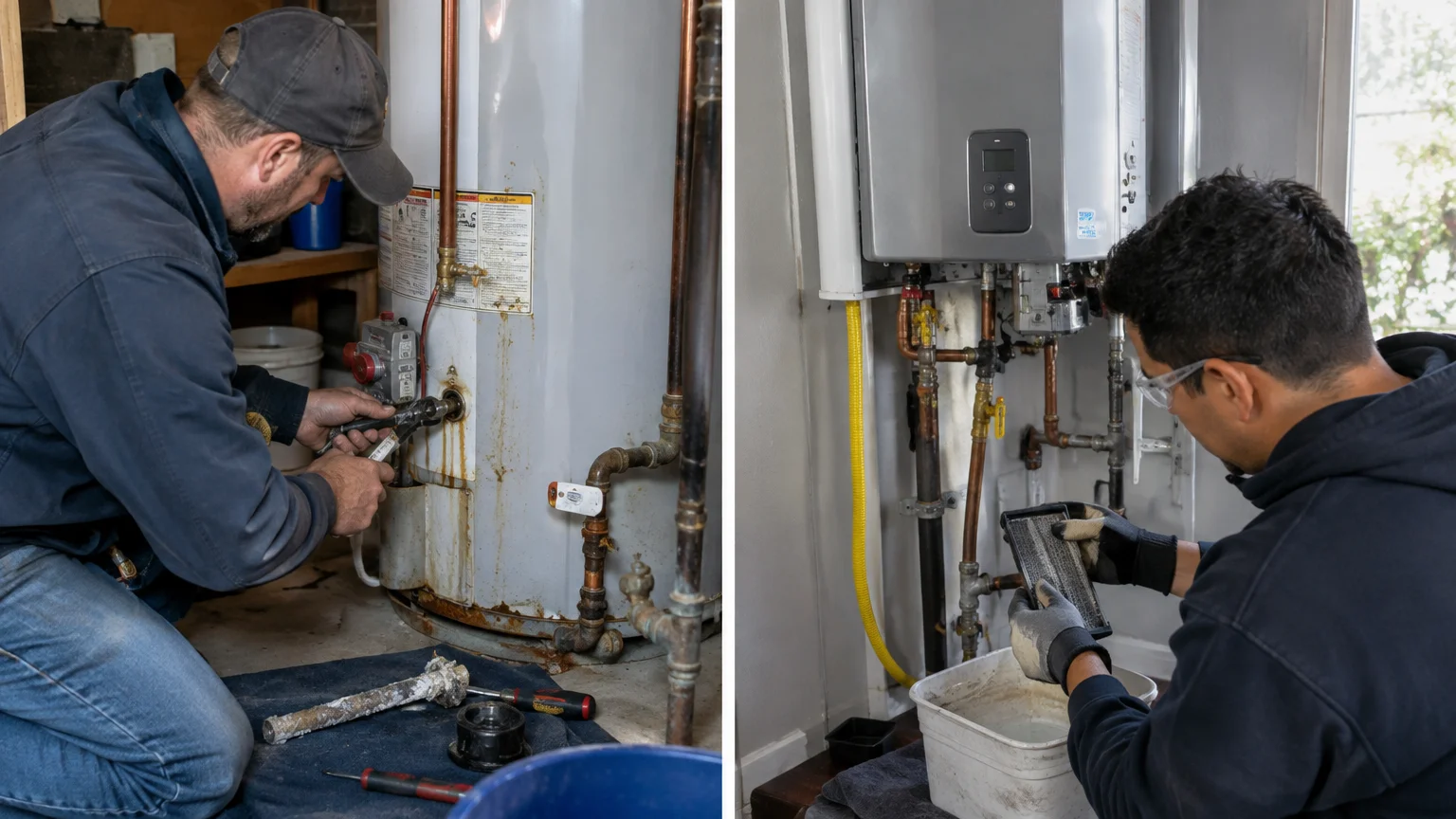
The best choice in a tankless water heater vs tank comparison depends on hot water use, space, fuel, and budget. Tankless units heat water as needed, while tank models store heated water. Each can work well when sized, installed, and maintained by a qualified plumber.\n\nA water heater affects daily comfort, safety, and utility use. A failing unit may cause cold showers, leaks, odd sounds, or water damage. The right replacement depends on household habits, pipe layout, venting, electrical supply, and local rules.\n\n## Table of Contents\n\n- What Is the Difference Between a Tankless Water Heater and a Tank Water Heater?\n- Which Water Heater Provides Better Energy Efficiency?\n- How Do Tankless and Tank Water Heaters Compare for Hot Water Capacity?\n- What Are the Installation Requirements for Each Type?\n- Which Water Heater Has Lower Long-Term Maintenance Needs?\n- How Does a Tankless Water Heater Compare With a Tank Over Time?\n- Should You Choose a Tankless Water Heater or a Tank?\n\n## What Is the Difference Between a Tankless Water Heater and a Tank Water Heater?\n\nA tank water heater stores hot water in an insulated container. A tankless water heater heats water when a tap or appliance needs it. This basic difference affects space, energy use, water supply, and installation work.\n\n### How storage-tank water heaters work\n\nA storage-tank unit uses a burner or electric elements to heat water. The tank keeps that water ready for use. Insulation holds much of the heat, but some heat escapes between uses. This is called standby heat loss.\n\nTank systems are common in American homes. They are familiar and often simple to replace. They can supply several fixtures at once when the tank holds enough hot water. When the supply runs low, the household must wait while the unit heats more water.\n\nTank water heaters come in several sizes and fuel types. Common choices include electric, natural gas, and propane models. The right option depends on fuel access, available space, hot water demand, and local installation rules.\n\n### How tankless water heaters heat water on demand\n\nA tankless unit has no large storage tank. When someone opens a hot water tap, a sensor starts the burner or heating elements. Water then moves through a heat exchanger. This part transfers heat into the water.\n\nSince the system does not keep a full tank hot, it can reduce standby heat loss. It also takes less floor space. Yet its output has limits. The unit must match the number of fixtures used together and the temperature of incoming water.\n\nBoth systems can fail without proper care. Water Heater Repair may help with leaks, weak heating, strange sounds, or error codes. A professional can explain whether repair makes sense or whether Water Heater Replacement is safer. Temple Texas Plumbing helps property owners compare these options based on the home’s real needs.\n\n## Which Water Heater Provides Better Energy Efficiency?\n\nTankless water heaters often use energy more efficiently because they heat water on demand. A tank unit uses energy to keep stored water hot. Actual results still depend on fuel type, household use, unit size, insulation, water temperature, and care.\n\n### How standby heat loss affects tank water heaters\n\nA tank water heater turns on and off to maintain its stored temperature. Heat slowly leaves the tank even when no one uses hot water. This is standby heat loss. Better insulation can lower it, but cannot remove it.\n\nA tank may suit a home with steady hot water use. It can deliver water quickly because the supply is already heated. Light use may leave more water available, while heavy use can make the tank recover slowly.\n\nEnergy use may rise when sediment builds up inside the tank. Sediment is mineral material that settles at the bottom. It can make heating less effective and place more strain on the unit. Regular service can help find this issue early.\n\n### What affects the efficiency of a tankless system\n\nA tankless unit avoids most standby heat loss. It turns on only when hot water is needed. Its performance depends on flow rate, heating power, water temperature settings, and incoming water temperature.\n\nThe system may work harder when cold water enters the home. Long showers, repeated laundry loads, and several hot water fixtures can also increase demand. Correct sizing matters more than choosing the largest unit available.\n\nHomeowners can safely fix dripping taps, use sensible temperature settings, and keep the heater area clear. They should not open gas controls, change wiring, or bypass safety parts. A trained professional should handle those tasks.\n\nTemple weather and water conditions may also affect a system choice. A plumbing professional can review the home instead of relying only on a product label. That review helps match the heater to actual use in Temple.\n\n## How Do Tankless and Tank Water Heaters Compare for Hot Water Capacity?\n\nA tank water heater offers a set amount of stored hot water. A tankless system can keep heating water while demand continues, but only within its flow and heating limits. The better option depends on how many people use hot water and when they use it.\n\n### What happens when a household uses hot water at the same time\n\nA storage tank may serve several fixtures until its hot water runs low. A large tub, shower, dishwasher, and washing machine can use the stored supply quickly. Afterward, the system needs time to heat more water.\n\nA tankless unit may provide a longer supply when demand stays within its rated flow. Too many fixtures can spread the available heat across several outlets. Water may become cooler, or flow may drop, if the unit cannot meet combined demand.\n\nHouseholds should list their main hot water activities before choosing a system. Note whether showers overlap, whether a large tub is used, and whether business sinks or equipment run together. This gives the installer useful information.\n\n### How flow rate and recovery time affect supply\n\nFlow rate describes how much water a heater can heat during use. It is considered with temperature rise. Temperature rise means the difference between incoming cold water and the desired hot water temperature. Both affect a tankless unit’s output.\n\nA tank model is judged by storage size and recovery rate. Recovery rate means how quickly the unit heats replacement water after the stored supply is used. Gas and electric models may recover at different speeds.\n\nThe system with the highest output is not always best. A unit that is too large may need extra equipment, while one that is too small may cause poor comfort. A qualified plumber can measure demand for a home, rental property, or business.\n\nIf hot water suddenly stops, the owner can check power, the breaker, and any clear gas appliance message. Do not relight equipment if there is a gas smell. Leave the area and contact the proper emergency service.\n\n## What Are the Installation Requirements for Each Type?\n\nTankless and tank water heaters may need different gas lines, vents, circuits, water connections, and drains. Professional sizing and installation help keep the system safe, reliable, and within local rules.\n\n### Space, venting, gas, and electrical considerations\n\nA tank heater needs room for the unit, service access, water connections, and a safe discharge path. It may also need a drain pan, based on its location and local rules. A leaking tank can release a large amount of water.\n\nTankless units are smaller, but they are not simple plug-in replacements. Gas models may need larger gas piping and approved vents. Electric models may need strong circuits and enough panel capacity. The installer must check these needs before equipment is selected.\n\nVenting carries combustion gases away from the building. It must use approved materials and follow the maker’s instructions. A blocked, damaged, or poorly fitted vent can create a serious safety risk.\n\nLocation matters as well. Outdoor units need protection from freezing weather. Indoor units need proper airflow, drainage, and service access. A professional can also check water pressure and pipe condition.\n\n### Why professional sizing and installation matter\n\nCorrect installation means more than connecting water lines. The installer must check capacity, fuel supply, vent design, electrical needs, temperature controls, safety valves, and drains. The work must follow local codes and maker instructions.\n\nPoor installation can cause leaks, weak heating, unsafe burning, error codes, or early failure. It may also affect an inspection or warranty claim. Professional Water Heater Installation helps reduce these risks.\n\nHomeowners can clear the work area, list hot water complaints, and gather information about the current unit. They can ask what care the new system needs. They should not change gas lines, wiring, vents, or pressure controls themselves.\n\nTemple Texas Plumbing serves the main Temple area, including Downtown, Midtown, Canyon Creek, Western Hills, Bird Creek, and nearby neighborhoods. Local experience can help account for a property’s age, layout, pipe condition, and service needs.\n\n## Which Water Heater Has Lower Long-Term Maintenance Needs?\n\nNeither system is maintenance-free. Tank heaters need checks for leaks, corrosion, sediment, valves, and anode condition. Tankless units need filter cleaning, inlet checks, and periodic flushing to remove mineral buildup.\n\n### Common maintenance for storage-tank units\n\n\n\nA tank system should be checked for rust, moisture, odd sounds, and changes in water temperature. A leaking tank may signal internal corrosion or a failed connection. Water around the base should never be ignored.\n\nThe temperature and pressure relief valve is an important safety part. It releases pressure when conditions become unsafe. It should not be blocked, capped, or removed. A plumber should inspect a valve that leaks or does not work correctly.\n\nAn anode rod helps protect the tank from corrosion. It slowly wears down as it attracts harmful elements in the water. Anode Rod Replacement Water Heater service may help extend tank life when done at the right time.\n\nSome homeowners can safely look for visible leaks and keep the area clear. They should not drain a hot tank without knowing the proper steps. Hot water can burn skin, and the wrong valve operation can cause damage.\n\n### Tankless system flushing and component checks\n\nTankless units often need flushing to remove mineral deposits from the heat exchanger. Mineral scale is hard buildup that can reduce heat transfer and restrict flow. Homes with hard water may need closer care.\n\nA technician may inspect inlet filters, water valves, burner parts, ignition parts, sensors, and vents. The service plan depends on the unit, water quality, fuel type, and maker’s instructions.\n\nA tankless unit may show warning codes for flow, temperature, ignition, or venting problems. The owner can record the code and check the manual. Do not remove covers or work on gas and electrical parts without proper training.\n\nRoutine care can help either system last longer. Repeated repairs, a leaking tank, poor output, or unsafe operation may point to replacement. Emergency Plumbing may be needed when a heater leaks badly or creates a water damage risk.\n\n## How Does a Tankless Water Heater Compare With a Tank Over Time?\n\nThe long-term choice depends on equipment life, repairs, energy use, maintenance, space, and comfort. A tankless system may use less energy during low-demand periods. A tank may offer a simpler replacement in an existing setup.\n\n### What influences installation and replacement needs\n\nReplacement work can be more involved when the new heater uses another fuel type or design. A tank-to-tank replacement may reuse some connections, but the installer must still check vents, valves, drains, and code needs.\n\nChanging from a tank to a tankless system may require new gas piping, venting, electrical work, mounting, or water connections. The property may need changes to support the unit’s output. These details affect the work plan and final quote.\n\nThe final cost is confirmed on a quote after the property and equipment needs are reviewed. The amount can vary with parts, system size, access, fuel type, venting, water damage, and urgency. Compare the full installation plan, not only the equipment label.\n\n### How operating life and energy use affect overall value\n\nA system’s value includes comfort, reliability, energy use, service needs, and the risk of early failure. A tankless system may suit a smaller space or a home that wants on-demand heating. A tank may work better where stored hot water and simple replacement matter most.\n\nOwners should consider future repairs as well. A unit with hard-to-find parts may be harder to service in an older property. A common system may be easier for local technicians to repair. Maker care instructions and warranty terms also matter.\n\nKeep records of repairs, flushing, valve checks, and replacement parts. These records help show repeated problems. They can also help a new owner or tenant understand the system.\n\nTemple Texas Plumbing can review the current water heater and explain whether repair or replacement fits the property. For customers in Temple, local service can help address leaks, poor heating, and urgent water heater problems before wider damage occurs.\n\n## Should You Choose a Tankless Water Heater or a Tank?\n\nA tankless heater may fit when space is limited, demand changes often, and the property supports the needed gas or electrical work. A tank may be more practical when stored hot water, simpler replacement, and familiar service matter most.\n\n### When a tankless system may be the better fit\n\nTankless systems can suit homes that want less standby heat loss and more floor space. They may also work well for additions, small utility areas, and properties with careful control of hot water use.\n\nThe owner should confirm that the system can meet peak demand. The installer must check incoming water temperature, flow needs, venting, fuel supply, and electrical capacity. Without these checks, the system may not provide the expected comfort.\n\nA tankless system is not the answer for every low-output problem. A blocked filter, bad sensor, scale buildup, or failed heating part may need repair instead. Proper testing should come before replacement.\n\n### When a conventional tank water heater may be more practical\n\nA tank may suit a household that uses several fixtures together but has an existing setup for direct replacement. It can also work well when the owner wants a familiar system and stored hot water.\n\nA tank is not automatically outdated or wasteful. A well-sized, well-insulated unit can serve a home reliably. Regular checks can help reduce leaks, sediment problems, and corrosion.\n\nThe final choice should fit the home, not a one-size-fits-all rule. A plumber can compare the current system, hot water habits, space, fuel, safety needs, and future plans. Contact us through Contact us to arrange help from Temple Texas Plumbing with repair, replacement, or installation.\n\n## Key Takeaways\n\n- Tank heaters store hot water, while tankless units heat water on demand.\n- Tankless systems can reduce standby heat loss but need careful sizing.\n- Tank systems may provide strong short-term output from stored hot water.\n- Both types need safety checks, care, and professional installation.\n- The right choice depends on demand, space, fuel, access, and future plans.\n\n## Frequently Asked Questions\n\n### Is a tankless water heater better than a tank heater?\n\nNeither option is always better. A tankless model may suit homes that want on-demand heating and less storage space. A tank may suit homes that need stored hot water and a simpler replacement. A professional should compare demand, fuel supply, installation needs, and maintenance before making a choice.\n\n### Can a tankless water heater run out of hot water?\n\nA tankless unit can keep heating water while demand stays within its flow and temperature range. It may struggle when too many fixtures run together. Poor sizing, cold incoming water, scale buildup, or low flow can also reduce performance. Correct design helps prevent these problems.\n\n### Does a tankless water heater need regular maintenance?\n\nYes. Many tankless systems need periodic flushing to remove mineral scale from the heat exchanger. Filters, sensors, burners, vents, and connections may also need checks. Needs vary by model and water quality. The maker’s instructions and a qualified technician should guide the service plan.\n\n### Can a homeowner install a tankless water heater?\n\nA homeowner can gather information, clear the work area, and check for visible leaks. Installation should be handled by a qualified professional because it may involve gas, high electrical loads, venting, water pressure, and local codes. Incorrect work can create fire, shock, carbon monoxide, or water damage risks.\n\n### When should a water heater be repaired instead of replaced?\n\nRepair may make sense when the problem involves a replaceable part, loose connection, sensor, valve, or control. Replacement may be wiser when the tank leaks, corrosion is severe, failures keep returning, or the unit no longer meets demand. A professional inspection can separate a repairable fault from a failing system.
If you are not sure what you are dealing with, it is worth having someone look at it before it turns into a bigger job. Get in touch with Temple Texas Plumbing in Temple, Texas today and we will tell you where you stand.